Case Study: Voice Assistant for a Fin-Tech Trading Platform
 Kasia Cieslak
Night Mode


Digital voice assistants, whether they’re on a mobile phone or a home-based device, are changing the way people gather information, operate their lives, and communicate. When we look at the market, Finances is the industry amongst leaders of developing customer experience through voice-first technology.
Goals
Xult is an innovative cryptocurrency exchange with the mission to deliver the best trading experience. They approached us with a very specific problem - they were about to launch a new product for professional and semi-professional cryptocurrency traders. They were looking for a new way to deliver exchange information to traders.
Overall goals were to:
- Create a solution that provides Xult's customers a modern tool to interact with the trading platform.
- Prepare a marketing strategy based on innovative technologies that can gather traction to Xult's newest currency exchange platform.
Process
With Xult, we were working in weekly sprints closing the entire project in 7 weeks with a following scope:
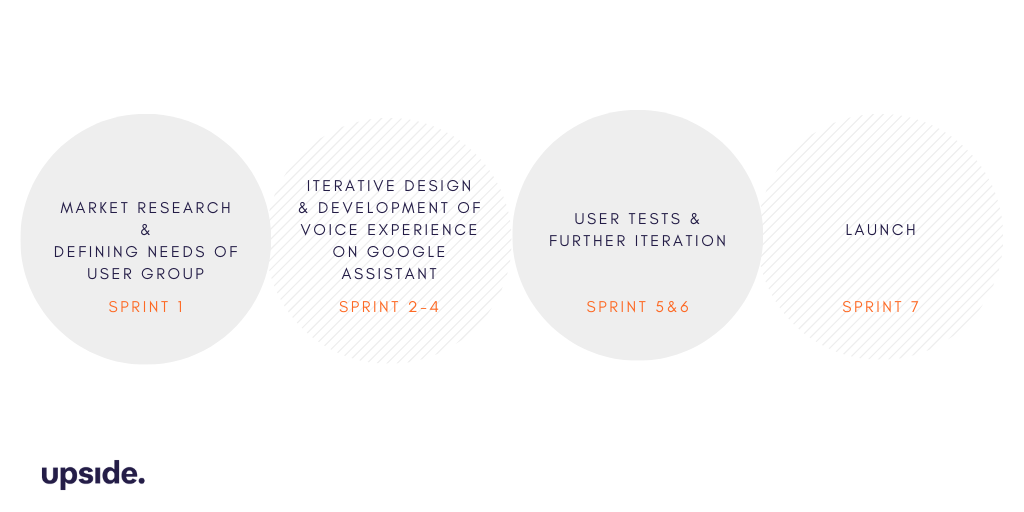
Our approach was focused on:
- Delivering the maximum value to the customer - by doing proper market research and building the right user persona (that included context where the user interacts with our solution).
- Delivering natural experience - by doing extensive user tests, we were able to make interactions as smooth as possible. Proper use of NLP allowed us to build a truly conversational experience that provides shortcuts to most important use cases.
Challenges when designing voice interactions for fintech
- Voice assistants in the fin-tech industry have a lot of potential, but also require extreme caution. Given the current market trends, customers are fine with accessing financial information via voice assistant, but are still reluctant to transactional actions.
- Presenting detailed information using a speech output is really demanding. It requires a lot of user testing and design efforts to make financial reports easy to consume for the users.
- Achieving compliance with Google's platform policy needs a lot of attention during the design phase, especially when dealing with financial services and transactions.
Results
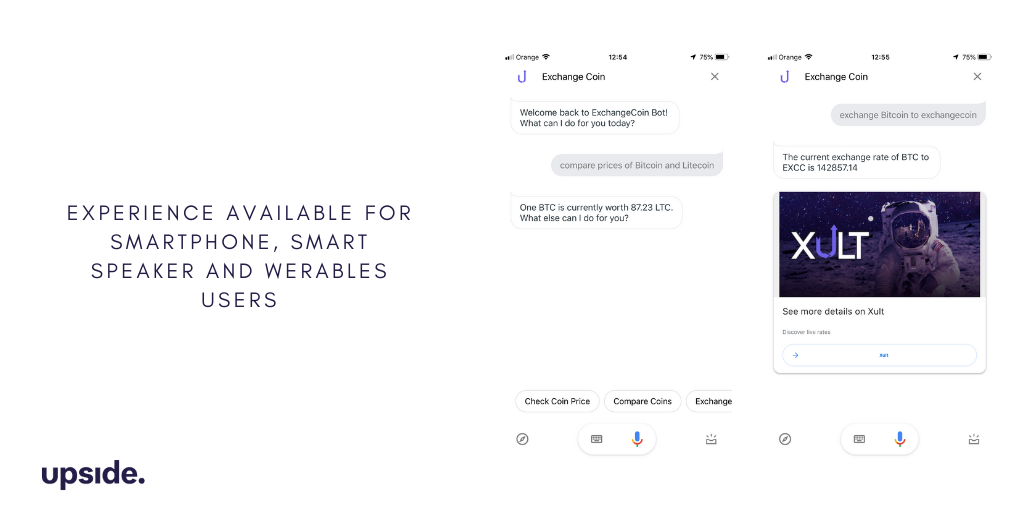
In 7 sprints we created a comprehensive voice assistant for Xult - Exchange Coin. It's a custom Google Assistant action, that offers latest information about customer's portfolio in Xult's platform.
Business Results:
- Increased customer engagement - with Google Assistant action, Xult's customers are able to access their services without installing anything on their smartphones.
- Shortcut to transactions - due to conversational nature of VUI, we're able to provide deep-links to complex actions. Customers can get relevant information on their Smartspeaker or Smartphone using only voice, then move to graphical interface on their phone to finalize transactions.
- Increased visibility - due to good PASO optimization, Google Assistant platform suggests Xult's action to customers asking about currency pair values. This brings in organic traffic on keywords that would be extremely expensive for example in AdWords.
Explore More Blog Posts
What is an agentic AI system for e-commerce?
An agentic AI system for e-commerce is software that autonomously plans and executes multi-step tasks across your commerce stack - from product discovery to order processing - without step-by-step human instruction. It uses large language models (LLMs) to reason, decide, and act on your behalf, grounded in your own product data.
 Kasia Ryniak
Field notes from HIMSS Europe 2026 in Copenhagen
My smartwatch knows more about my body on an average Tuesday than my hospital does. It tracks how I slept, how hard my heart worked on a run, whether I am trending in the wrong direction before I feel anything at all. The institution with the doctors, the scanners and a century of clinical knowledge mostly meets me when something has already gone wrong.
 Daniel Hekman
How AI is Replacing Us (and Reinventing) the Way We Work as a Software Consultancy
Earlier this year, I got a message. “You have to check out Claude. Look what I’ve been able to do in a couple of hours”. What followed was a link to something that, frankly, should have taken a few days to put together.
 Rafal Cymerys